The Covid-19 pandemic is a social and an economic crisis just as much as it is a health one – its repercussions, severe and far-reaching, are being felt across the world.
From school closures to devastated industries and millions of jobs lost – the social and economic costs of the pandemic are many and varied. Covid-19 is threatening to widen inequalities everywhere, undermine progress on global poverty and clean energy, and more.
The best solution is to stop this damage from happening, through the use of tests, treatments and vaccines everywhere they’re needed. This will cost only a fraction of the huge economic loss the pandemic is causing every week.
The pandemic impacts all aspects of society
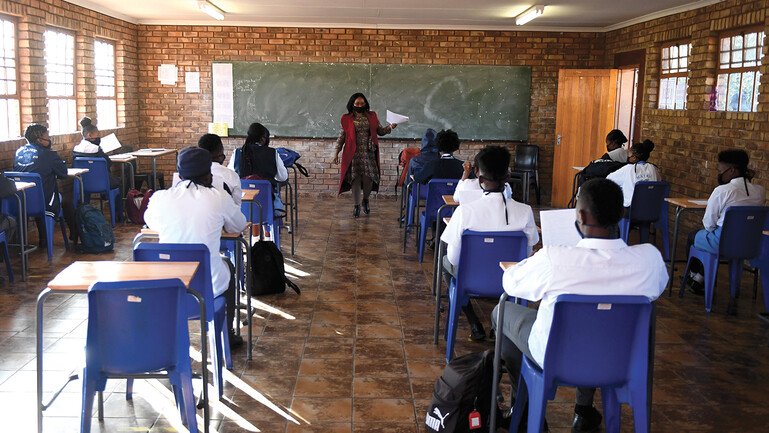
To slow the spread of the virus, schools closed across the world. One year into the pandemic, almost half of the world’s students are still affected by school closures. Millions of girls in some countries might not be going back at all, putting them at risk of adolescent pregnancy, child marriage and violence.

Businesses closed too, leading to the equivalent of 255 million full-time jobs lost, in terms of working hours, in 2020. Among the worst hit are workers in the informal economy, young people and women. Any economic recovery will likely be uneven, leading to greater inequality in the coming years.
Women have been harder hit economically by the pandemic because they are a large proportion of the workers in sectors severely affected by Covid-19, including accommodation and food services, and in front-line occupations, such as the health and social care sectors.
With the closures of schools, they have also had to take on more care responsibilities at home. Whether through job losses or school closures, the pandemic threatens to undo decades of progress on gender equality.
Covid-19 has been slowing down progress on clean energy too, at least temporarily, by curbing investments and delaying the expansion of clean energy technologies.
There has been some positive climate news: global energy-related CO2 emissions fell by 5.8% in 2020, the largest ever decline in global CO2 emissions in history. But that’s only a short-term effect of lockdowns, not a sustained change. In fact, emissions are expected to rise by 4.8% in 2021, the second highest rate in history, as the demand for coal, oil and gas rebounds with the economy.
No epidemic is ever just a health issue in isolation, and Covid-19 has emphasised this on the global stage. We need to be looking at it in terms of an economic issue, a livelihood issue, a social issue and a political issue too.
It’s setting us back on decades of progress in tackling global poverty
The pandemic will likely trigger the biggest recession since World War II, causing a financial loss twice as great as during the 2008 recession. That’s a staggering $12 trillion the global economy will lose over 2020 and 2021.

The effects are felt unevenly across societies.
While no economy is left untouched, lower- and middle-income countries are worst affected because they have weak defences against economic shocks and tend to depend more on a few sectors, such as commodities and tourism.
Millions of people have already fallen below the poverty line. In just a few months of Covid-19, extreme poverty went up for the first time in 20 years.
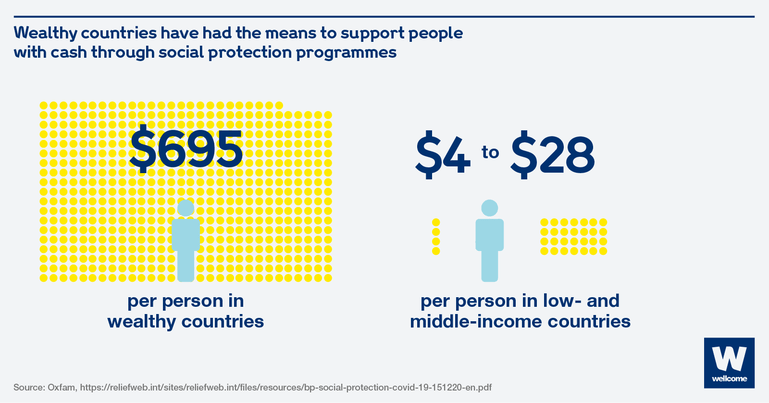
Wealthy countries have had the means to intervene early to protect people and businesses, by pumping $9.8 trillion into their economies, the biggest chunk of the total of $11.7 trillion spent globally, to cope with the fallout from the pandemic. But low- and middle-income countries have not been able to do the same.
A report by Oxfam reviewed the government measures to support people through the pandemic in 126 low- and middle-income countries, including numerous kinds of benefits for those affected, and found that 97% of the support provided was inadequate to meet basic needs.